4 Functions
Alongside sets, functions are the second foundational pillar of modern mathematics. In this unit, we define the concept of a function, introduce first properties of functions, and give an overview of several elementary functions.
4.1 Definition and properties
Definition 4.1 (Function) A function or mapping \(f\) is an assignment rule that assigns exactly one element of a set \(Z\) to each element of a set \(D\). \(D\) is called the domain of \(f\), and \(Z\) is called the codomain of \(f\). We write
\[\begin{equation} f : D \to Z, x \mapsto f(x), \end{equation}\]
where \(f : D \to Z\) is read as “the function \(f\) maps all elements of the set \(D\) uniquely to elements in \(Z\)” and \(x \mapsto f(x)\) is read as “\(x\), which is an element of \(D\), is mapped by the function \(f\) to \(f(x)\), where \(f(x)\) is an element of \(Z\).” The arrow \(\to\) denotes the mapping between the sets \(D\) and \(Z\), while the arrow \(\mapsto\) denotes the mapping between an element of \(D\) and an element of \(Z\).
It is essential to distinguish between the function \(f\) as an assignment rule and a value of the function \(f(x)\) as an element of \(Z\). \(x\) is the argument of the function (the function’s input), and \(f(x)\) is the value that the function \(f\) takes for the argument \(x\) (the function’s output). Usually, the definition of a function specifies, after \(f(x)\), the functional form of \(f\), that is, a rule for forming the value \(f(x)\) from \(x\). For example, in the following definition of a function
\[\begin{equation} f : \mathbb{R} \to \mathbb{R}_{\ge 0}, x \mapsto f(x) := x^2 \end{equation}\]
the definition of a power is used. Note that functions are always unique in the sense that, whenever the function is applied, they always assign one and the same \(f(x) \in Z\) to each \(x \in D\).
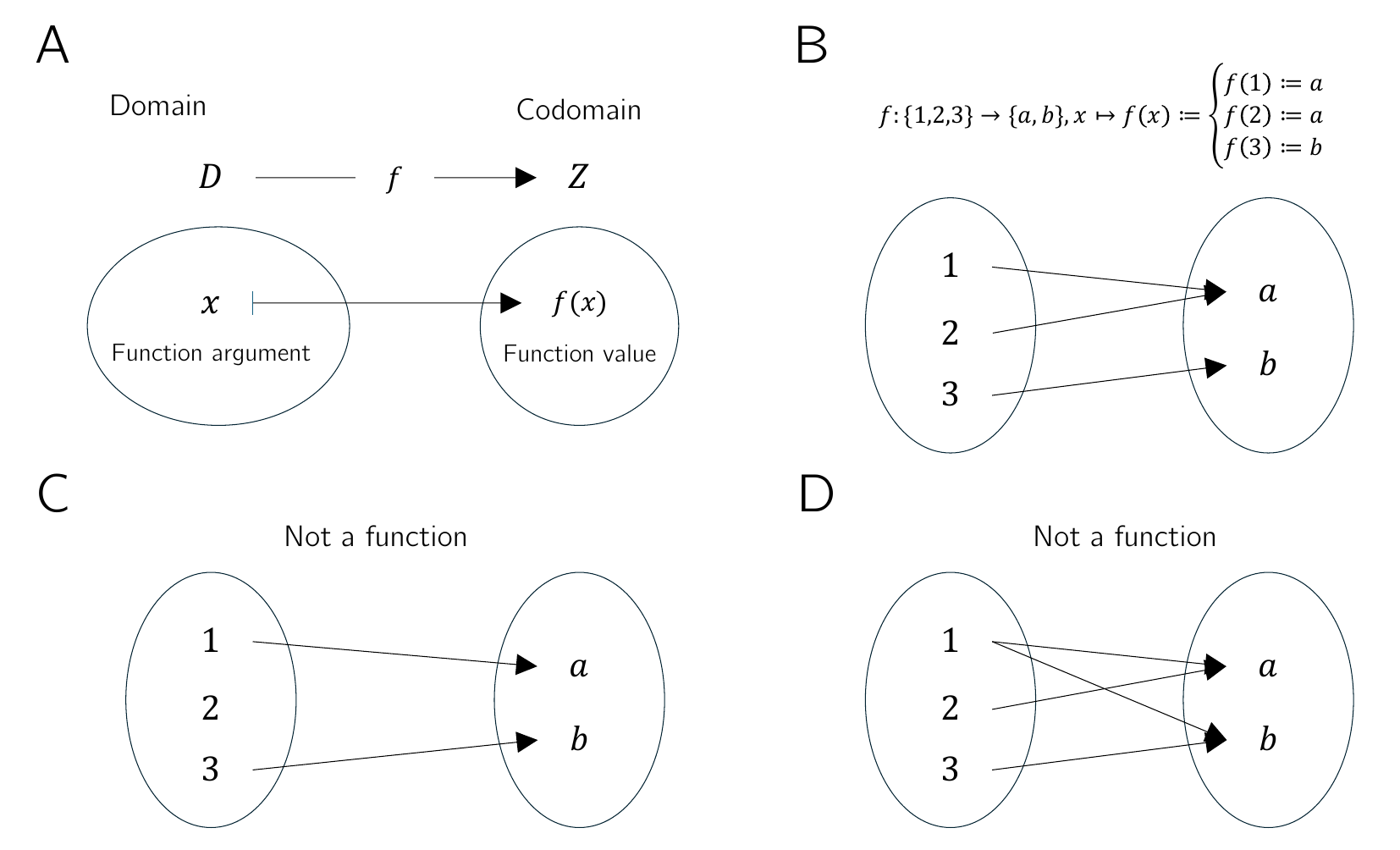
Figure 4.1 illustrates several aspects of the definition of a function. Panel A depicts its central concepts. Panel B shows a first example in which function values are assigned directly rather than determined by a calculation rule. Panels C and D use counterexamples to highlight two aspects of the definition. Panel C does not depict a function, because according to Definition 4.1, a function assigns exactly one element of a codomain \(Z\) to every element of a domain \(D\). The assignment shown leaves \(2 \in D\) without an element in \(Z\) and is therefore not a function. Likewise, Definition 4.1 requires exactly one element of the codomain \(Z\) for each element of \(D\). In panel D, \(1 \in D\) is assigned both \(a \in Z\) and \(b \in Z\), which is incompatible with Definition 4.1.
Thus, functions put elements of sets into relation with one another. The sets of these elements receive special names.
Definition 4.2 (Image, range, preimage set, preimage) Let \(f : D \to Z, x \mapsto f(x)\) be a function and let \(D' \subseteq D\) and \(Z' \subseteq Z\). The set
\[\begin{equation} f(D') := \{z \in Z | \mbox{there exists an } x \in D' \mbox{ with } z = f(x)\} \end{equation}\]
is called the image of \(D'\), and \(f(D) \subseteq Z\) is called the range of \(f\). Furthermore, the set
\[\begin{equation} f^{-1}(Z') := \{x \in D | f(x) \in Z'\} \end{equation}\]
is called the preimage set of \(Z'\). An \(x \in D\) with \(z = f(x) \in Z\) is called a preimage of \(z\).
Note that the range \(f(D)\) of \(f\) and the codomain \(Z\) of \(f\) need not be identical.
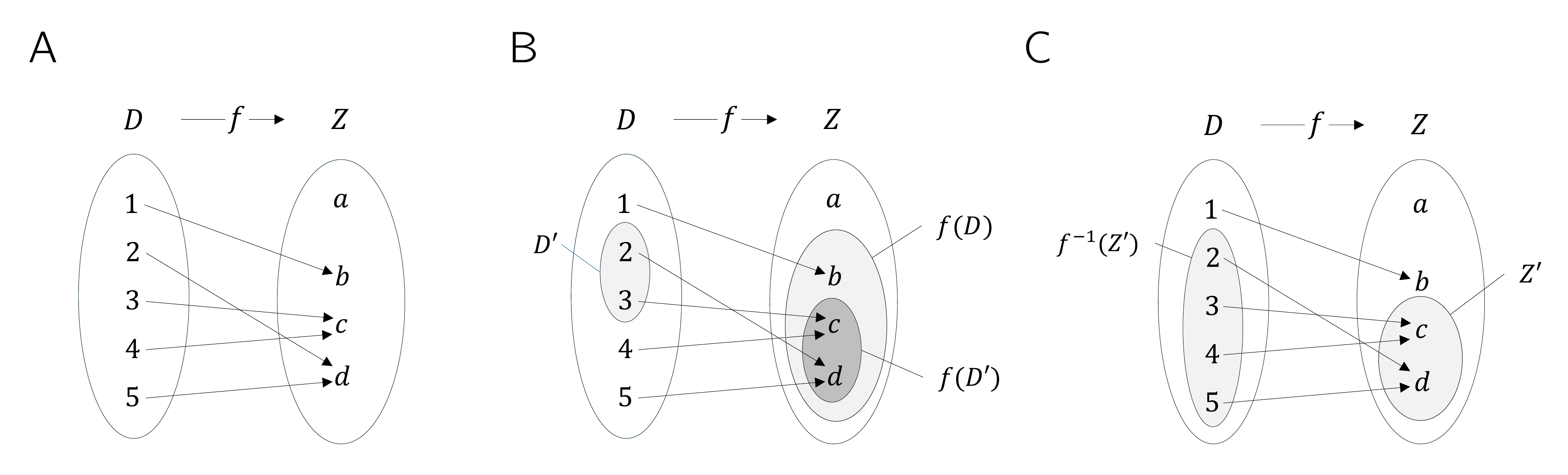
Example 4.1 (Image, range, preimage set, and preimage) To illustrate the concepts introduced in Definition 4.2, consider the function shown in Figure 4.2 A, \[ f : \{1,2,3,4,5\} \to \{a,b,c,d\}, x \mapsto \begin{cases} f(1) & := b \\ f(2) & := d \\ f(3) & := c \\ f(4) & := c \\ f(5) & := d \end{cases}. \tag{4.1}\] According to Definition 4.2, an image is always defined relative to a subset \(D'\) of the domain \(D\). Let \(D' := \{2,3\} \subset D\), as shown in panel B. The image of \(D'\) is the set of \(z \in Z\) for which there is an \(x \in D'\) such that \(z = f(x)\). Here, these elements are precisely \(c,d \in Z\), because \(f(2) = d\) and \(f(3) = c\). There are no further \(z \in Z\) with \(f(x) = z\) and \(x \in \{2,3\}\). The range \(f(D)\) is the subset of \(z \in Z\) for which there is an \(x \in D\) with \(z = f(x)\). This holds for all elements of \(Z\) except \(a \in Z\), since no \(x \in D\) satisfies \(a = f(x)\). The range of the function considered is therefore \(f(D) := \{b,c,d\}\).
Conversely, according to Definition 4.2, a preimage set is always defined relative to a subset \(Z'\) of the codomain \(Z\). Let \(Z' := \{c,d\} \subset Z\), as shown in Figure 4.2 C. The preimage set of \(Z'\) is the set of \(x \in D\) for which \(f(x) \in Z'\). The elements of \(D\) whose function values under \(f\) belong to \(Z'\) are precisely \(\{2,3,4,5\}\). In contrast, \(1 \in D\) is not an element of \(f^{-1}(Z')\), because \(f\) maps \(1 \in D\) to \(b \in Z\) and \(b \notin Z'\). Nevertheless, \(1 \in D\) is of course a preimage of \(b\).
Basic properties of functions are named in the following definition.
Definition 4.3 (Injectivity, surjectivity, bijectivity) Let \(f : D \to Z, x \mapsto f(x)\) be a function.
The function \(f\) is injective if every image \(z \in f(D)\) has exactly one preimage \(x \in D\). Equivalently, \(f\) is injective if \(x_1,x_2 \in D\) with \(x_1 \neq x_2\) implies \(f(x_1) \neq f(x_2)\).
The function \(f\) is surjective if \(f(D) = Z\), that is, if every element of the codomain \(Z\) has a preimage in the domain \(D\).
The function \(f\) is bijective if it is both injective and surjective. Bijective functions are also called one-to-one correspondences.
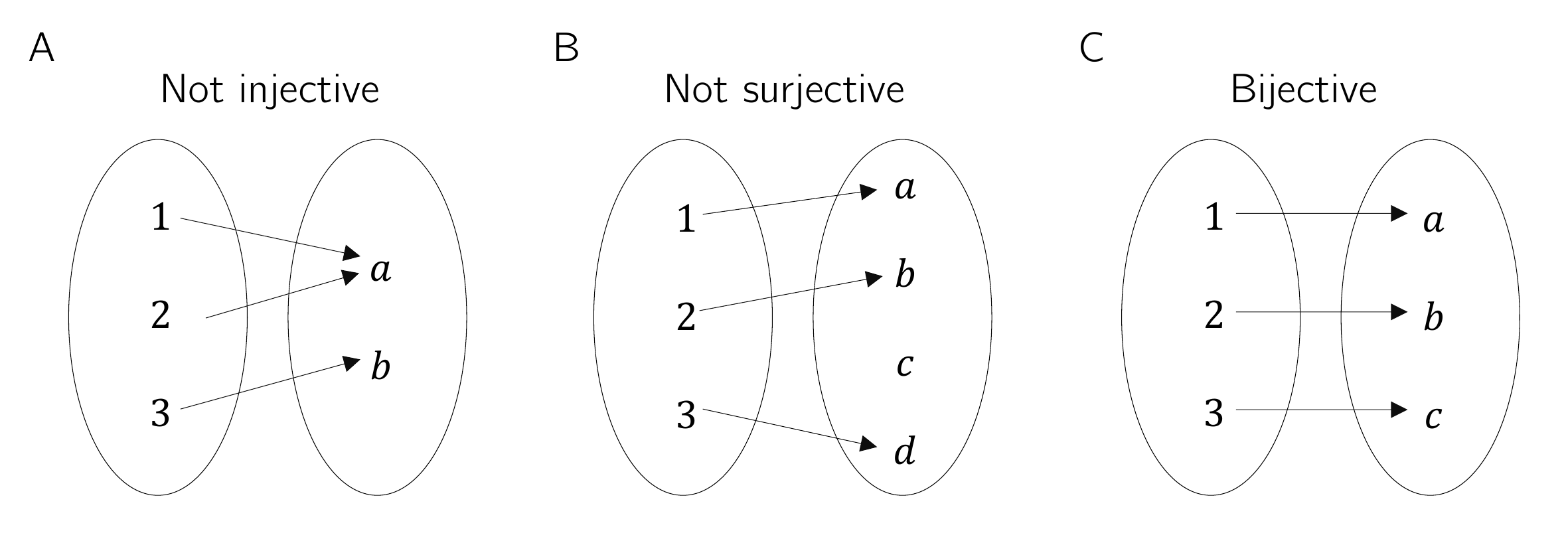
Example 4.2 (Injectivity, surjectivity, bijectivity) We first illustrate Definition 4.3 using three examples and counterexamples in Figure 4.3. Panel A shows the non-injective function
\[\begin{equation} f : \{1,2,3\} \to \{a,b\}, x \mapsto \begin{cases} f(1) & := a \\ f(2) & := a \\ f(3) & := b \end{cases}. \end{equation}\]
The function is non-injective because the element \(a\) in the range of \(f\) has more than one preimage in the domain of \(f\), namely the elements \(1\) and \(2\). Figure 4.3 B shows the non-surjective function
\[\begin{equation} g : \{1,2,3\} \to \{a,b,c,d\}, x \mapsto \begin{cases} g(1) & := a \\ g(2) & := b \\ g(3) & := d \end{cases}. \end{equation}\]
The function is non-surjective because the element \(c\) in the codomain of \(g\) has no preimage in the domain of \(g\). Finally, Figure 4.3 C shows the bijective function
\[\begin{equation} h : \{1,2,3\} \to \{a,b,c\}, x \mapsto \begin{cases} h(1) & := a \\ h(2) & := b \\ h(3) & := c \end{cases}. \end{equation}\]
For every element in the codomain of \(h\) there is exactly one preimage, so the function is injective and surjective and therefore bijective.
As a further example, consider the function
\[\begin{equation} f : \mathbb{R} \to \mathbb{R}, x \mapsto f(x) := x^2 \end{equation}\]
This function is not injective because, for example, with \(x_1 = 2 \neq -2 = x_2\) we have \(f(x_1) = 2^2 = 4 = (-2)^2 = f(x_2)\). Moreover, \(f\) is not surjective because, for example, \(-1 \in \mathbb{R}\) has no preimage under \(f\). However, if the domain of \(f\) is restricted to the non-negative real numbers, that is, if we define the function
\[\begin{equation} \tilde{f} : [0,\infty[ \to [0,\infty[, x \mapsto \tilde{f}(x) := x^2, \end{equation}\]
then, in contrast to \(f\), \(\tilde{f}\) is injective and surjective, hence bijective.
Example 4.3 (On the uncountability of the real numbers) We now use surjectivity and bijectivity to examine the uncountability of the real numbers more closely (see Section 2.3). This means that there are different kinds of infinity, which is certainly not easy to grasp intuitively. Specifically, we sketch Cantor’s diagonal argument (Cantor (1891), Gray (1994)) for the uncountability of the real numbers. We begin by specifying what finite and countably infinite sets mean in terms of bijective mappings.
Definition 4.4 (Finite and countably infinite sets) A set \(M\) is finite if \(M = \emptyset\) or if, for some \(n \in \mathbb{N}\), there is a bijective mapping
\[\begin{equation} f : \mathbb{N}_n \to M \end{equation}\]
Furthermore, a set \(M\) is countably infinite if there is a bijective mapping
\[\begin{equation} f : \mathbb{N} \to M \end{equation}\]
onto the elements of \(M\).
For a finite set, a bijective mapping assigns each element a natural number with a maximum value \(n < \infty\). For a countably infinite set, each element can at least be assigned a natural number. The elements of these sets can therefore be counted. Cantor (1891) showed that this is impossible for the real numbers. No bijection between the natural and real numbers can be constructed. In fact, even the open interval \(]0,1[\) is uncountable. To prove this by contradiction, suppose that there is a surjective function
\[\begin{equation} f : \mathbb{N} \to ]0,1[, n \mapsto f(n). \end{equation}\]
Then every number in \(]0,1[\) would have to occur as \(f(n)\) for at least one \(n \in \mathbb{N}\). To see why this is impossible, first write each \(f(n)\) in its decimal expansion
\[\begin{equation} f(n) = 0{,}a_{n,1}a_{n,2}a_{n,3}\ldots, \end{equation}\]
where \(a_{n,k} \in \{0,1,\ldots,9\}\) denotes the \(k\)-th decimal digit of \(f(n)\). Such a supposedly complete list might begin as in Table 4.1.
| \(n\) | \(f(n)\) | ||||||||||
|---|---|---|---|---|---|---|---|---|---|---|---|
| \(1\) | \(0{.}\) | 3 | 1 | 4 | 1 | 5 | 9 | 2 | 6 | 5 | \(\cdots\) |
| \(2\) | \(0{.}\) | 8 | 9 | 4 | 5 | 9 | 7 | 8 | 1 | 0 | \(\cdots\) |
| \(3\) | \(0{.}\) | 9 | 6 | 2 | 3 | 2 | 1 | 5 | 8 | 7 | \(\cdots\) |
| \(4\) | \(0{.}\) | 5 | 3 | 6 | 8 | 8 | 8 | 9 | 7 | 3 | \(\cdots\) |
| \(5\) | \(0{.}\) | 7 | 4 | 3 | 8 | 1 | 8 | 0 | 9 | 7 | \(\cdots\) |
| \(\vdots\) | \(\vdots\) |
We now construct another decimal number. For each \(n \in \mathbb{N}\), consider the \(n\)-th decimal digit of \(f(n)\), that is, the bold diagonal digits in Table 4.1. If this digit differs from \(1\), replace it by \(1\). If it equals \(1\), replace it by \(2\). For the first five rows of the example, this gives the construction in Table 4.2.
| \(n\) | \(f(n)\) | ||||||||||
|---|---|---|---|---|---|---|---|---|---|---|---|
| \(1\) | \(0{.}\) | 1 | 1 | 4 | 1 | 5 | 9 | 2 | 6 | 5 | \(\cdots\) |
| \(2\) | \(0{.}\) | 8 | 1 | 4 | 5 | 9 | 7 | 8 | 1 | 0 | \(\cdots\) |
| \(3\) | \(0{.}\) | 9 | 6 | 1 | 3 | 2 | 1 | 5 | 8 | 7 | \(\cdots\) |
| \(4\) | \(0{.}\) | 5 | 3 | 6 | 1 | 8 | 8 | 9 | 7 | 3 | \(\cdots\) |
| \(5\) | \(0{.}\) | 7 | 4 | 3 | 8 | 2 | 8 | 0 | 9 | 7 | \(\cdots\) |
| \(\vdots\) | \(\vdots\) |
The bold digits define a new number \(z\). In the example shown, it begins with
\[\begin{equation} z = 0{,}11112\ldots \end{equation}\]
and continues by the same procedure for all subsequent rows. Since every decimal digit of \(z\) is either \(1\) or \(2\), \(z\) lies in \(]0,1[\). The number \(z\) differs from \(f(1)\) in the first decimal place, from \(f(2)\) in the second, and in general from \(f(n)\) in the \(n\)-th decimal place. Thus, \(z \neq f(n)\) for every \(n \in \mathbb{N}\). Hence, \(z\) is not in the range of \(f\), contradicting the assumption that \(f\) is surjective. There is therefore no surjection, and in particular no bijection, from \(\mathbb{N}\) to \(]0,1[\). The interval \(]0,1[\) is consequently uncountable rather than countably infinite. Since \(]0,1[ \subset \mathbb{R}\), the real numbers are also uncountable.
4.2 Types of functions
By composition, further functions can be formed from given functions.
Definition 4.5 (Composition of functions) Let \(f : D \to Z\) and \(g : E \to S\) be functions with \(f(D) \subseteq E\). Thus, the range of \(f\) is contained in the domain of \(g\). Then
\[\begin{equation} g \circ f : D \to S, x \mapsto (g \circ f)(x) := g(f(x)) \end{equation}\]
defines a function called the composition of \(f\) and \(g\).
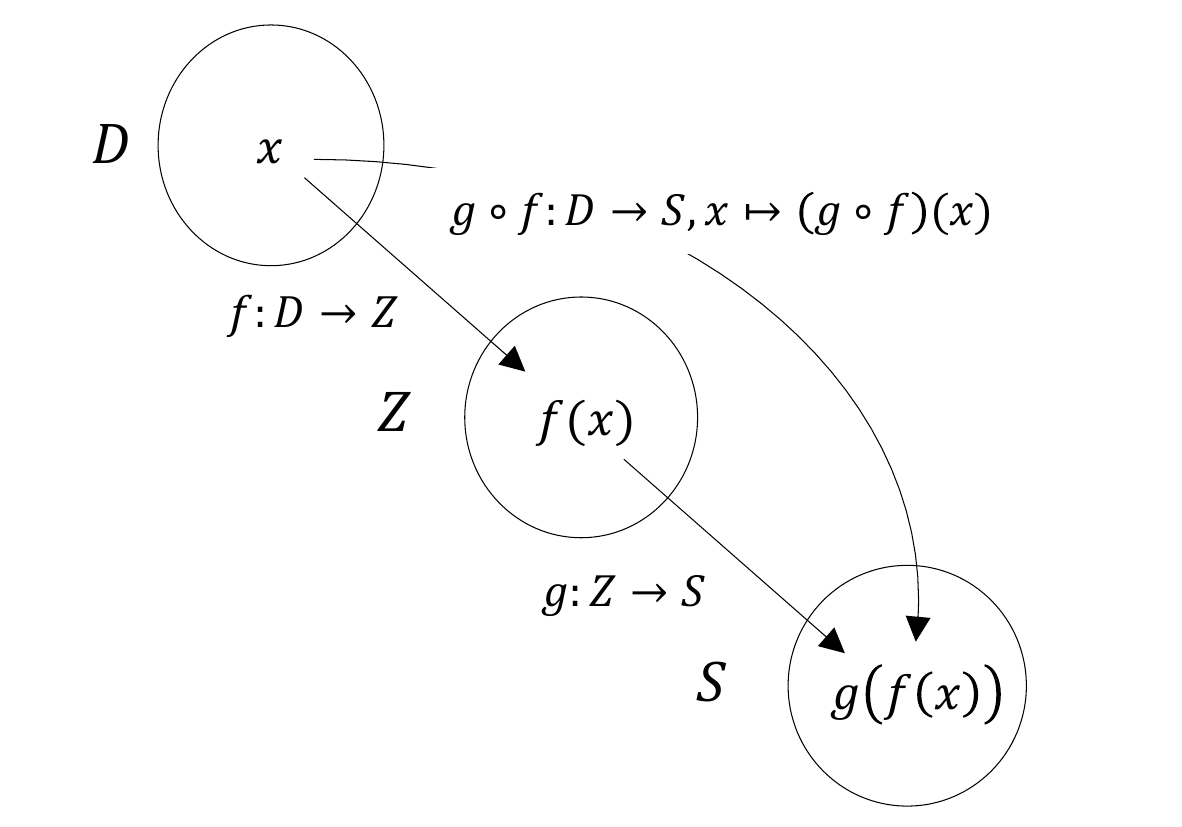
The notation for composed functions takes a little getting used to. It is important to recognize that \(g \circ f\) denotes the composed function and \((g \circ f)(x)\) denotes an element in the codomain of the composed function. Intuitively, when evaluating \((g \circ f)(x)\), one first applies the function \(f\) to \(x\) and then applies the function \(g\) to the element \(f(x)\) of \(Z\). This is captured by the functional form \(g(f(x))\). For simplicity, the composition of two functions is often denoted by a single letter. For example, one writes \(h := g \circ f\) with \(h(x) = g(f(x))\). A mild source of confusion can arise when elements in the codomain of \(f\) are denoted by \(y\), so that the notation \(y = f(x)\) and \(h(x) = g(y)\) is used. However, this notation is sometimes needed for notational simplicity. We visualize Definition 4.5 in Figure 4.4.
As an example of the composition of two functions, consider
\[\begin{equation} f : \mathbb{R} \to \mathbb{R}, x \mapsto f(x) := -x^2 \end{equation}\]
and
\[\begin{equation} g : \mathbb{R} \to \mathbb{R}, x \mapsto g(x) := \exp(x). \end{equation}\]
In this case, the composition of \(f\) and \(g\) is
\[\begin{equation} g \circ f : \mathbb{R} \to \mathbb{R}, x \mapsto (g \circ f)(x) := g(f(x)) = \exp\left(-x^2\right). \end{equation}\]
A first application of function composition appears in the following definition.
Definition 4.6 (Inverse function) Let \(f : D \to Z, x \mapsto f(x)\) be a bijective function. The function \(f^{-1} : Z \to D\) that assigns each \(z \in Z\) its unique preimage in \(D\) is called the inverse function, or simply the inverse of \(f\). We have
\[\begin{equation} f^{-1}(f(x)) = x \mbox{ for all } x \in D \end{equation}\]
and
\[\begin{equation} f(f^{-1}(z)) = z \mbox{ for all } z \in Z. \end{equation}\]
Inverse functions are always bijective. This follows because \(f\) is bijective and therefore each \(x \in D\) is assigned exactly one \(f(x) = z \in Z\). Hence, each \(z \in Z\) is also assigned exactly one \(x \in D\), namely \(f^{-1}(f(x)) = x\). Intuitively, the inverse function of \(f\) undoes the effect of \(f\) on an element \(x\). We visualize Definition 4.6 in Figure 4.5 A.
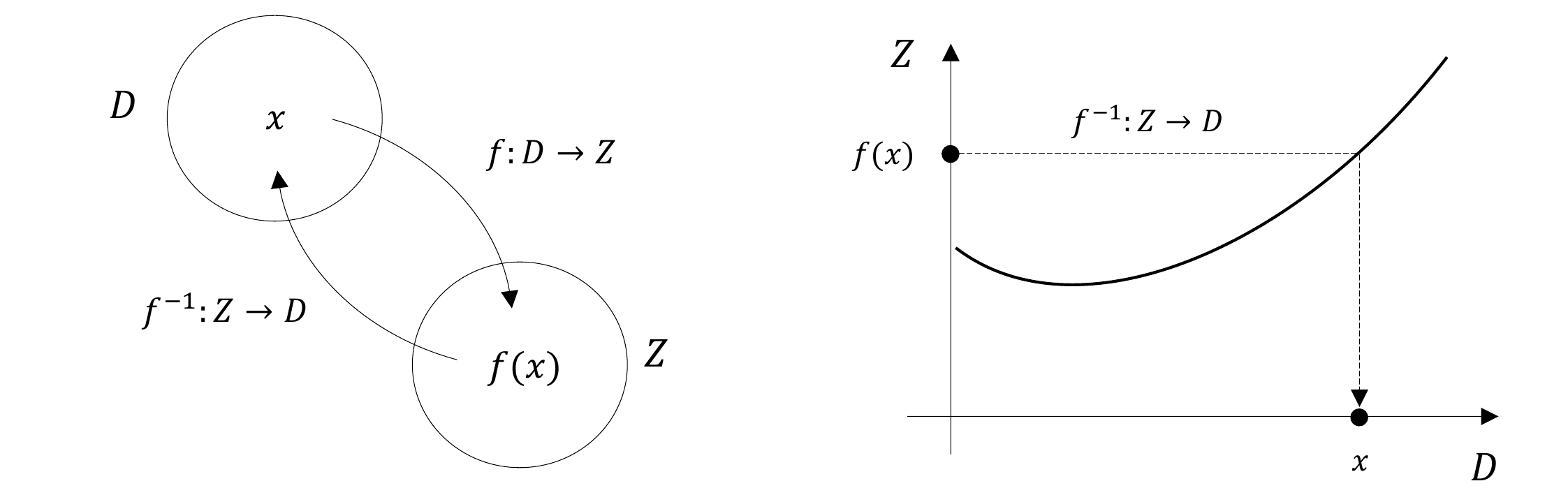
For the graph of a function in a Cartesian coordinate system, evaluating the function leads from a value on the \(x\)-axis to a value on the \(y\)-axis. Evaluating the inverse function accordingly leads from a value on the \(y\)-axis to a value on the \(x\)-axis. This is illustrated in Figure 4.5 B. For example, consider the function
\[\begin{equation} f : \mathbb{R} \to \mathbb{R}, x \mapsto f(x) := 2x =: y. \end{equation}\]
Then the inverse function of \(f\) is given by
\[\begin{equation} f^{-1} : \mathbb{R} \to \mathbb{R}, y \mapsto f^{-1}(y) := \frac{1}{2}y, \end{equation}\]
because for every \(x \in \mathbb{R}\),
\[\begin{equation} (f^{-1} \circ f)(x) = f^{-1}(f(x)) = f^{-1}(2x) = \frac{1}{2}\cdot 2x = x. \end{equation}\]
An important class of functions consists of linear maps.
Definition 4.7 (Linear map) Let \(D\) and \(Z\) be real vector spaces. A mapping \(f : D \to Z, x \mapsto f(x)\) is called a linear mapping if, for all \(x,y \in D\) and all \(c \in \mathbb{R}\),
\[\begin{equation} f(x + y) = f(x) + f(y) \tag*{(additivity)} \end{equation}\]
and
\[\begin{equation} f(cx) = cf(x). \tag*{(Homogenität)} \end{equation}\]
A mapping that does not satisfy these conditions is called a nonlinear mapping.
Linear maps are often known as “straight lines.” The general definition of linear maps is not completely congruent with this intuition. In particular, linear maps are only those functions that map zero to zero. We show this in the following theorem.
Theorem 4.1 (Linear map of zero) Let \(f : D \to Z\) be a linear map. Then
\[\begin{equation} f(0) = 0. \end{equation}\]
Proof. First note that by additivity of \(f\),
\[\begin{equation} f(0) = f(0 + 0) = f(0) + f(0). \end{equation}\]
Adding \(-f(0)\) to both sides of the equation above gives
\[\begin{equation} f(0) - f(0) = f(0) + f(0) - f(0) \Leftrightarrow f(0) = 0 \end{equation}\]
and this proves the claim.
We illustrate the concept of a linear map with two examples.
- For \(a \in \mathbb{R}\), the map
\[\begin{equation} f : \mathbb{R} \to \mathbb{R}, x \mapsto f(x) := ax \end{equation}\]
is a linear map because
\[\begin{equation} f(x + y) = a(x + y) = ax + ay = f(x) + f(y) \mbox{ and } f(cx) = acx = cax = cf(x). \end{equation}\]
- For \(a,b \in \mathbb{R}\) with \(b \neq 0\), in contrast, the mapping
\[\begin{equation} f : \mathbb{R} \to \mathbb{R}, x \mapsto f(x) := ax + b \end{equation}\]
is nonlinear because, for example, for \(a := b := 1\),
\[\begin{equation} f(x + y) = 1(x + y) + 1 = x + y + 1 \neq x + 1 + y + 1 = f(x) + f(y). \end{equation}\]
A map of the form \(f(x) := ax + b\) is called a linear-affine map or linear-affine function. Somewhat imprecisely, functions of the form \(f(x) := ax + b\) are sometimes also called linear functions.
Besides the types of functions discussed so far, there are many further classes of functions. In the following definition, we classify functions by the dimensionality of their domains and codomains. This type of function classification is often helpful for gaining an initial overview of a mathematical model.
Definition 4.8 (Function types) We distinguish
- univariate real-valued functions of the form
\[\begin{equation} f : \mathbb{R} \to \mathbb{R}, x \mapsto f(x), \end{equation}\]
- multivariate real-valued functions of the form
\[\begin{equation} f : \mathbb{R}^n \to \mathbb{R}, x \mapsto f(x) = f(x_1, \ldots, x_n), \end{equation}\]
- and multivariate vector-valued functions of the form
\[\begin{equation} f : \mathbb{R}^n \to \mathbb{R}^m, x \mapsto f(x) = \begin{pmatrix} f_1(x_1, \ldots, x_n) \\ \vdots \\ f_m(x_1, \ldots, x_n) \end{pmatrix}, \end{equation}\]
where \(f_i\), \(i = 1,\ldots,m\), are called the component functions of \(f\).
In physics, multivariate real-valued functions are called scalar fields, and multivariate vector-valued functions are called vector fields. In some applications, matrix-variate matrix-valued functions also occur.
4.3 Elementary functions
By elementary functions we mean a small set of univariate real-valued functions that frequently appear as building blocks of more complex functions. These are the polynomial functions, the exponential function, the logarithm function, and the gamma function. In the following, we give the definitions of these functions and state their main properties as theorems, and then present their graphs. For proofs of the properties introduced here, we refer to the advanced literature.
Definition 4.9 (Polynomial functions) For \(k \in \mathbb{N}^0\) and \(a_0,a_1,\ldots,a_k \in \mathbb{R}\), a function of the form
\[\begin{equation} f : \mathbb{R} \to \mathbb{R}, x \mapsto f(x) := \sum_{i = 0}^{k} a_i x^i = a_0 + a_1 x + \cdots + a_k x^k \end{equation}\]
is called a polynomial function. If \(a_k \neq 0\), its degree is \(k\). If all coefficients are zero, it is called the zero polynomial. Here, we do not assign a degree to the zero polynomial.
Typical polynomial functions are listed in the following table.
| Name | Functional form | Coefficients |
|---|---|---|
| Constant function | \(f(x) = a\) | \(a_0 := a\), \(a_i := 0\), \(i > 0\) |
| Identity function | \(f(x) = x\) | \(a_0 := 0\), \(a_1 := 1\), \(a_i := 0\), \(i > 1\) |
| Affine function | \(f(x) = ax + b\) | \(a_0 := b\), \(a_1 := a\), \(a_i := 0\), \(i > 1\) |
| Square function | \(f(x) = x^2\) | \(a_0 := 0\), \(a_1 := 0\), \(a_2 := 1\), \(a_i := 0\), \(i > 2\) |
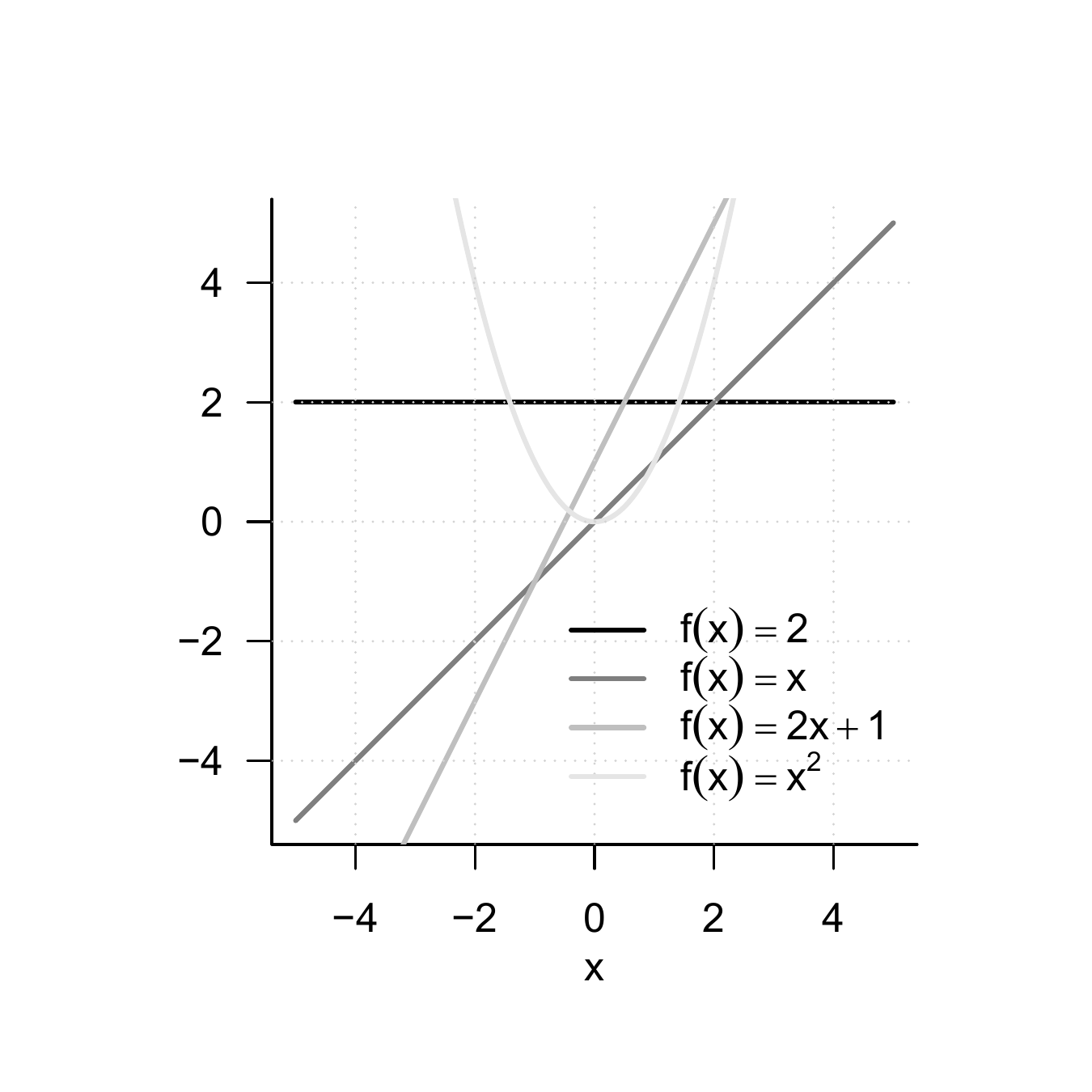
Figure 4.6 shows the graphs of the polynomial functions listed in Definition 4.9.
An important pair of functions consists of the exponential function and the logarithm function.
Theorem 4.2 (Exponential function and its properties) The exponential function is defined as
\[\begin{equation} \exp : \mathbb{R} \to \mathbb{R}_{>0}, x \mapsto \exp(x) := e^x := \sum_{n = 0}^\infty \frac{x^n}{n!} = 1 + x + \frac{x^2}{2!} + \frac{x^3}{3!} + \frac{x^4}{4!} + \cdots \end{equation}\]
The exponential function has the properties listed in the following table, where \(x,y \in \mathbb{R}\).
| Property | Meaning |
|---|---|
| Range | \(x \in ]-\infty,0[ \Rightarrow \exp(x) \in ]0,1[\) |
| \(x \in ]0,\infty[ \Rightarrow \exp(x) \in ]1,\infty[\) | |
| Monotonicity | \(x < y \Rightarrow \exp(x) < \exp(y)\) |
| Special values | \(\exp(0) = 1\) and \(\exp(1) = e\) |
| Addition property | \(\exp(x + y) = \exp(x)\exp(y)\) |
| Subtraction property | \(\exp(x - y) = \frac{\exp(x)}{\exp(y)}\) |
In particular, the exponential function takes only positive values and intersects the \(y\)-axis at \(x = 0\). The number \(\exp(1) := e \approx 2.71\ldots\) is called Euler’s number. Finally, the special values of the exponential function also give
\[\begin{equation} \exp(x)\exp(-x) = \exp(x - x) = \exp(0) = 1. \end{equation}\]
Theorem 4.3 (Logarithm function and its properties) The logarithm function is defined as the inverse function of the exponential function,
\[\begin{equation} \ln : ]0,\infty[ \to \mathbb{R}, x \mapsto \ln(x) \mbox{ with } \ln(\exp(x)) = x \mbox{ for all } x \in \mathbb{R}. \end{equation}\]
The logarithm function has the properties listed in the following table, where \(x,y > 0\) and \(c \in \mathbb{R}\).
| Property | Meaning |
|---|---|
| Range | \(x \in ]0,1[ \Rightarrow \ln(x) \in ]-\infty,0[\) |
| \(x \in ]1,\infty[ \Rightarrow \ln(x) \in ]0,\infty[\) | |
| Monotonicity | \(x < y \Rightarrow \ln(x) < \ln(y)\) |
| Special values | \(\ln(1) = 0\) and \(\ln(e) = 1\) |
| Product property | \(\ln(xy) = \ln(x) + \ln(y)\) |
| Power property | \(\ln(x^c) = c\ln(x)\) |
| Division property | \(\ln\left(\frac{1}{x}\right) = -\ln(x)\) |
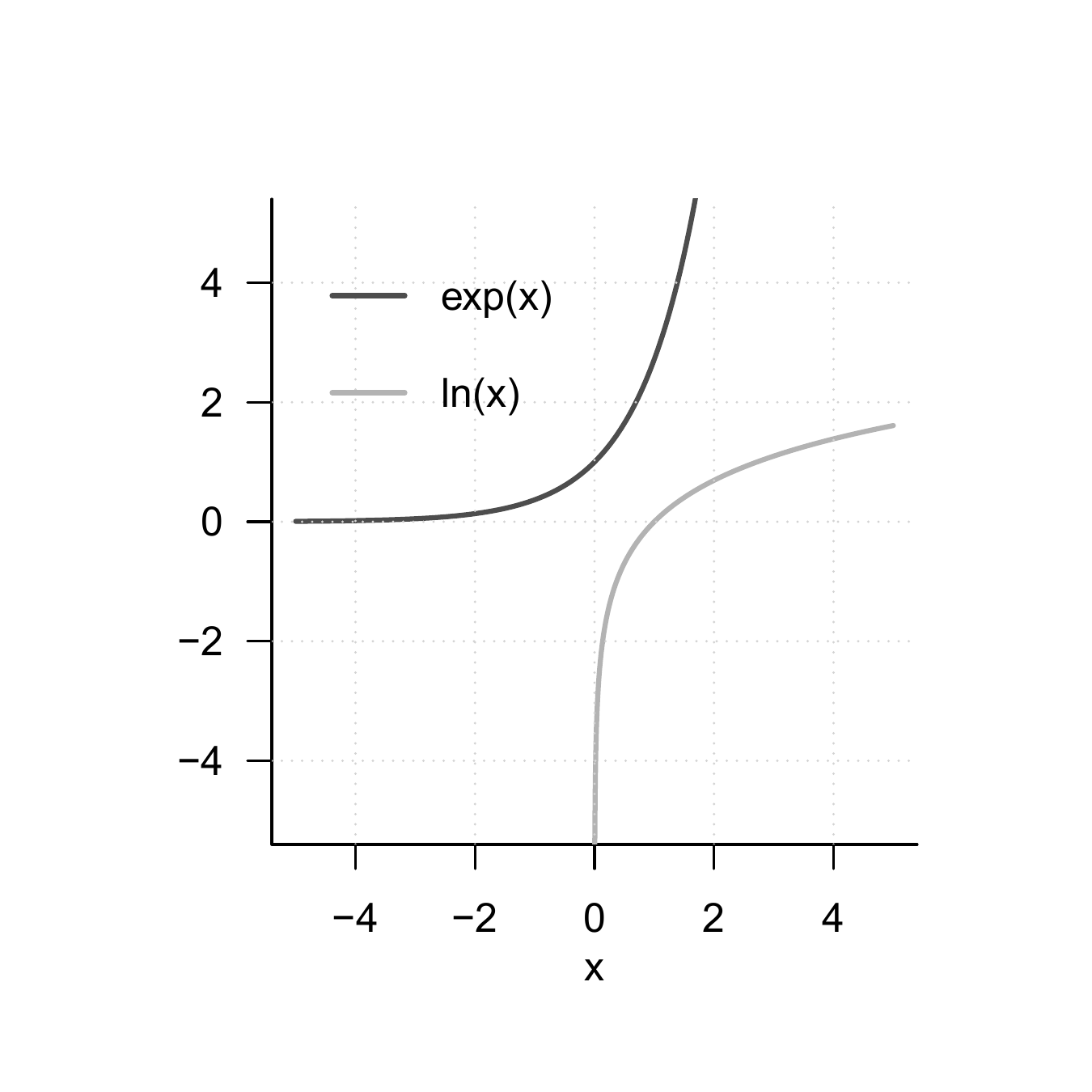
Unlike the exponential function, the logarithm function takes both negative and positive values. It intersects the \(x\)-axis at \(x = 1\). The product and power properties are central to calculations with logarithms. An intuitive way to remember them is: “The logarithm turns products into sums and powers into products.” The graphs of the exponential and logarithm functions are shown in Figure 4.7.
A frequent companion in probability theory is the gamma function.
Theorem 4.4 (Gamma function and its properties) For positive real arguments, the gamma function is defined by
\[\begin{equation} \Gamma : \mathbb{R}_{>0} \to \mathbb{R}_{>0}, x \mapsto \Gamma(x) := \int_0^\infty \xi^{x - 1}\exp(-\xi)\, d\xi. \end{equation}\]
The gamma function has the properties listed in the following table.
| Property | Meaning |
|---|---|
| Special values | \(\Gamma(1) = 1\) |
| \(\Gamma\left(\frac{1}{2} \right) = \sqrt{\pi}\) | |
| \(\Gamma(n) = (n-1)!\) for \(n \in \mathbb{N}\) | |
| Recursion property | For \(x>0\), \(\Gamma(x+1) = x\Gamma(x)\) |
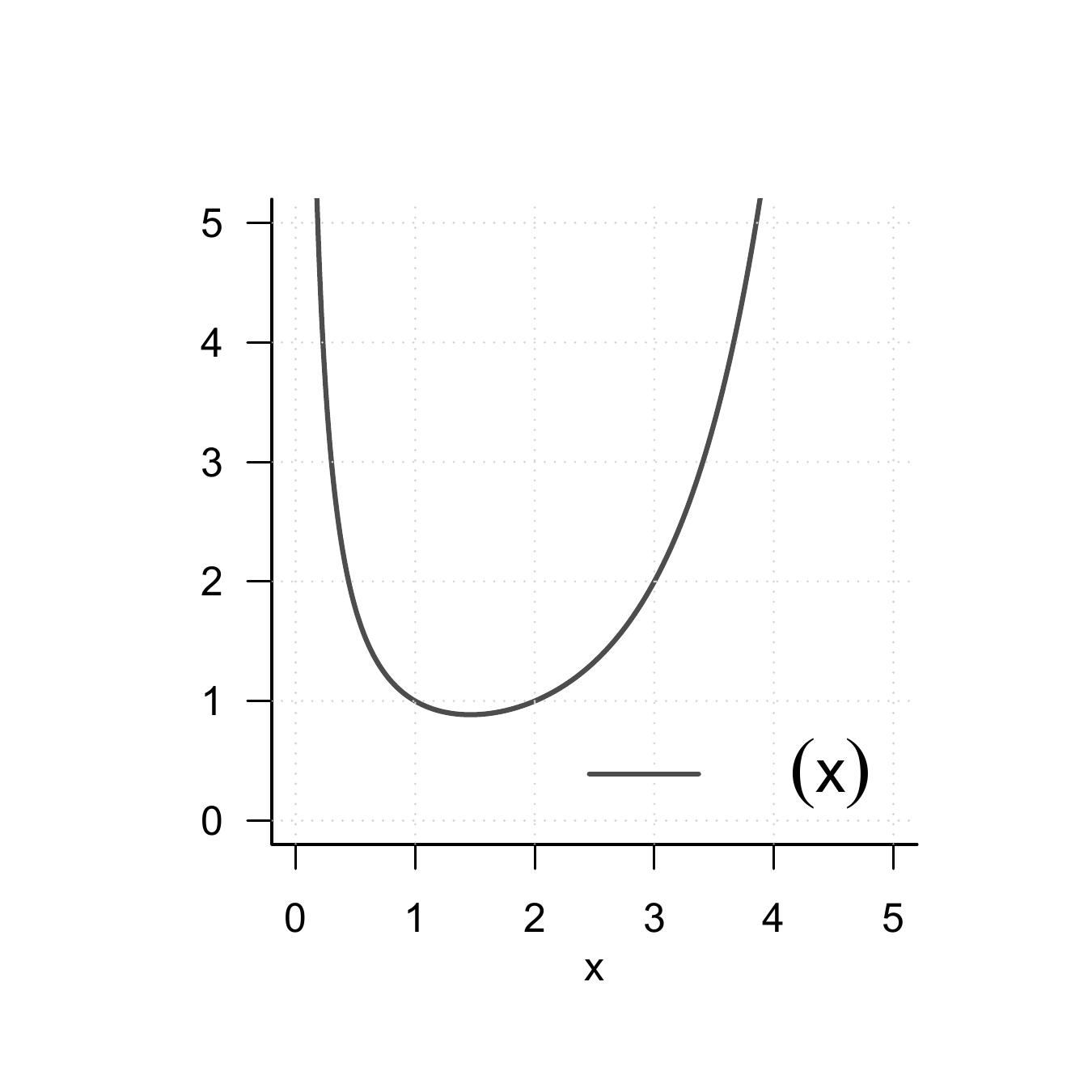
A section of the graph of the gamma function is shown in Figure 4.8.
Study questions
Let \(\mathbb{R}_{\ge 0} := \{x \in \mathbb{R} | x \ge 0\}\) denote the set of nonnegative real numbers.
State the definition of a function.
State the definitions of image, range, preimage set, and preimage.
State the definitions of surjectivity, injectivity, and bijectivity.
Explain why \(f : \mathbb{R} \to \mathbb{R}, x \mapsto f(x) := x^2\) is neither injective nor surjective.
Explain why \(f : \mathbb{R}_{\ge 0} \to \mathbb{R}_{\ge 0}\), \(x \mapsto f(x) := x^2\), is bijective.
State the definition of the composition of functions.
State the definition of an inverse function.
Give the inverse of \(f : \mathbb{R}_{\ge 0} \to \mathbb{R}_{\ge 0}\), \(x \mapsto f(x) := x^2\).
State the definition of a linear mapping.
State the definitions of univariate real-valued, multivariate real-valued, and multivariate vector-valued functions.
State the addition and subtraction properties of the exponential function.
State the product, power, and division properties of the logarithm function.
Sketch the identity function and the constant function for \(a := 1\).
Sketch the linear function \(f(x) = ax + b\) for \(a = 2\) and \(b = 3\).
Sketch \(f(x) := (x - 1)^2\) and \(g(x) := (x + 3)^2\).
Sketch the exponential and logarithm functions.
Study question answers
See Definition 4.1.
See Definition 4.2.
See Definition 4.3.
The function is not injective, since \(f(-2) = f(2) = 4\), although \(-2 \neq 2\). It is not surjective, since negative real numbers have no preimage under \(f\).
The function is bijective, since for every \(z \in \mathbb{R}_{\ge 0}\) there is exactly one \(x \in \mathbb{R}_{\ge 0}\) with \(f(x) = z\), namely \(x = \sqrt{z}\).
See Definition 4.5.
See Definition 4.6.
The inverse function is
\[\begin{equation} f^{-1} : \mathbb{R}_{\ge 0} \to \mathbb{R}_{\ge 0}, z \mapsto f^{-1}(z) := \sqrt{z}. \end{equation}\]
For \(x,z \in \mathbb{R}_{\ge 0}\), we have \(f^{-1}(f(x)) = \sqrt{x^2} = x\) and \(f(f^{-1}(z)) = (\sqrt{z})^2 = z\).
See Definition 4.7.
See Definition 4.8.
For \(x,y \in \mathbb{R}\), we have
\[\begin{equation} \begin{aligned} & \exp(x + y) = \exp(x)\exp(y) \\ & \exp(x - y) = \frac{\exp(x)}{\exp(y)}. \end{aligned} \end{equation}\]
See Theorem 4.2.
- For \(x,y > 0\) and \(c \in \mathbb{R}\), we have
\[\begin{equation} \begin{aligned} & \ln(xy) = \ln(x) + \ln(y) \\ & \ln(x^c) = c\ln(x) \\ & \ln\left(\frac{1}{x}\right) = -\ln(x). \end{aligned} \end{equation}\]
See Theorem 4.3.
The graph of the identity function is the line through \((0,0)\) and \((1,1)\). The graph of the constant function with \(a = 1\) is the horizontal line through \((0,1)\). See Figure 4.6.
The graph of \(f(x) = 2x + 3\) is a line with slope \(2\) and intercept \(3\). For example, it passes through \((0,3)\) and \((1,5)\). See Table 4.3.
Both graphs are upward-opening unit parabolas. The graph of \(f(x) = (x - 1)^2\) has vertex \((1,0)\), and that of \(g(x) = (x + 3)^2\) has vertex \((-3,0)\). They are obtained from the graph of the square function by shifting it \(1\) unit to the right and \(3\) units to the left, respectively. See Figure 4.6.
See Figure 4.7. The exponential function is strictly increasing, passes through \((0,1)\), and approaches the \(x\)-axis as \(x \to -\infty\). The logarithm function is strictly increasing, passes through \((1,0)\), and has the vertical asymptote \(x = 0\). The two graphs are reflections of each other across the line \(y = x\).